Overview
Summary
- An antenna is a transducer — it converts a guided electrical signal traveling down a transmission line into a radiated electromagnetic wave, and does the exact reverse on receive.
- Reciprocity means, with rare exceptions, the same physical antenna works equally well for transmitting and receiving — an antenna doesn't "know" which direction the signal is flowing.
- The shape of an antenna is really a decision about tradeoffs: how much gain you want, in which direction(s), over what bandwidth, and in how small a physical package. See Antenna Types for the full catalog of shapes that trade off those properties differently.
Think of an antenna as:
"A funnel for electromagnetic energy — the same funnel works pouring energy out (transmit) or catching it (receive), and the funnel's shape decides whether it catches everything around it a little, or one specific direction a lot."
If you are confused...
I am confused too... but don't worry! For the actual catalog of antenna shapes — dipoles, horns, patches, reflectors, and everything in between — see Antenna Types.
What an Antenna Actually Does
At its core, every antenna is just a structure sized to resonate at (or near) the wavelength of the signal it's meant to handle — a plain half-wave dipole, for instance, is literally cut to half the wavelength of its target frequency. Get that sizing right, and the antenna efficiently converts current flowing through it into radiated fields (or vice versa); get it wrong, and most of the energy just reflects back down the feedline instead of radiating.
Key Antenna Parameters
Every antenna type on the types page can be described using the same handful of parameters — worth understanding these first, since they're what actually distinguishes one type from another.
Radiation Pattern
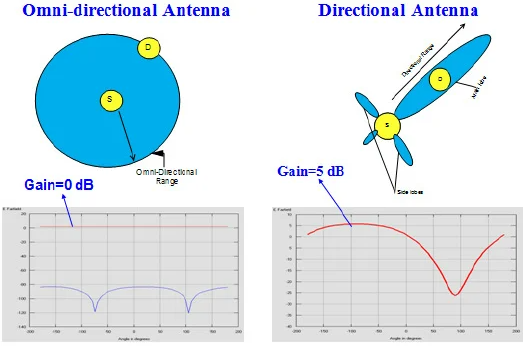
Figure 1. Antenna radiation patterns: an omnidirectional pattern (equal in all directions around one axis) vs. a directional pattern (concentrated toward one main lobe, with smaller side lobes)1
The radiation pattern is a plot of how much energy an antenna sends in each direction — usually shown as a polar plot, since that maps naturally onto "how strong is the signal at each angle." Every real antenna has some directionality; a perfectly equal-in-all-directions isotropic radiator is a theoretical reference point, not something that actually exists, but it's the baseline everything else gets compared against.
Gain
Gain measures how much an antenna concentrates energy in its strongest direction, relative to a reference:
- dBi — gain relative to a theoretical isotropic radiator (the universal, most-used reference)
- dBd — gain relative to a real
-
ResearchGate. (n.d.). Radiation Patterns of Omnidirectional and Directional Antennas. https://www.researchgate.net/figure/Radiation-Patterns-of-Omnidirectional-and-Directional-Antennas_fig3_268268627. ↩